An Incredibly Small Space to Pass Through:
On Metaphor, Relation, and the Resonant Murk
“you just have to let the soft animal of your body love what it loves”
and also
“don’t love your life too much”
Mary Oliver, excerpts from Wild Geese and One or Two Things, 1986
An Incredibly Small Space to Pass Through:
On Metaphor, Relation, and the Resonant Murk
“you just have to let the soft animal of your body love what it loves”
and also
“don’t love your life too much”
Mary Oliver, excerpts from Wild Geese and One or Two Things, 1986
An Incredibly Small Space to Pass Through:
On Metaphor, Relation, and the Resonant Murk
“you just have to let the soft animal of your body love what it loves”
and also
“don’t love your life too much”
Mary Oliver, excerpts from Wild Geese and One or Two Things, 1986
An Incredibly Small Space to Pass Through:
On Metaphor, Relation, and the Resonant Murk
“you just have to let the soft animal of your body love what it loves”
and also
“don’t love your life too much”
Mary Oliver, excerpts from Wild Geese and One or Two Things, 1986
An Incredibly Small Space to Pass Through:
On Metaphor, Relation, and the Resonant Murk
“you just have to let the soft animal of your body love what it loves”
and also
“don’t love your life too much”
Mary Oliver, excerpts from Wild Geese and One or Two Things, 1986
An Incredibly Small Space to Pass Through:
On Metaphor, Relation, and the Resonant Murk
“you just have to let the soft animal of your body love what it loves”
and also
“don’t love your life too much”
Mary Oliver, excerpts from Wild Geese and One or Two Things, 1986
An Incredibly Small Space to Pass Through:
On Metaphor, Relation, and the Resonant Murk
“you just have to let the soft animal of your body love what it loves”
and also
“don’t love your life too much”
Mary Oliver, excerpts from Wild Geese and One or Two Things, 1986
An Incredibly Small Space to Pass Through:
On Metaphor, Relation, and the Resonant Murk
“you just have to let the soft animal of your body love what it loves”
and also
“don’t love your life too much”
Mary Oliver, excerpts from Wild Geese and One or Two Things, 1986
An Incredibly Small Space to Pass Through:
On Metaphor, Relation, and the Resonant Murk
you just have to let the soft animal of your body love what it loves
and also
don’t love your life too much
Mary Oliver, from Wild Geese and One or Two Things, 1986
An Incredibly Small Space to Pass Through:
On Metaphor, Relation, and the Resonant Murk
you just have to let the soft animal of your body love what it loves
and also
don’t love your life too much
Mary Oliver, from Wild Geese and One or Two Things, 1986
An Incredibly Small Space to Pass Through:
On Metaphor, Relation, and the Resonant Murk
you just have to let the soft animal of your body love what it loves
and also
don’t love your life too much
Mary Oliver, from Wild Geese and One or Two Things, 1986
An Incredibly Small Space to Pass Through:
On Metaphor, Relation, and the Resonant Murk
you just have to let the soft animal of your body love what it loves
and also
don’t love your life too much
Mary Oliver, from Wild Geese and One or Two Things, 1986
An Incredibly Small Space to Pass Through:
On Metaphor, Relation, and the Resonant Murk
you just have to let the soft animal of your body love what it loves
and also
don’t love your life too much
Mary Oliver, from Wild Geese and One or Two Things, 1986

THE LITTLE GHOST
Who can be Included, and How: An Ethos and Approach
Having taken a break, I walk around the block. I go to my favourite nearby spot, a big patch of rock between some apartment buildings. The clouds have cleared a bit, we are still somehow in that space between the bright light and the dead of winter, where there is a dark grey to the sky but such a bright light to the grounded objects. Moss so neon green, rock so grey it’s blue-ish. I have heard in the north there is more ultraviolet light. Maybe the season’s edge and the day’s edge brings it out, disco of the dead and dying.
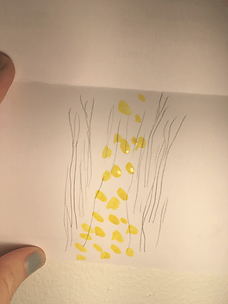
To my right is a dark grey path, dotted almost evenly with golden leaves, brilliant. I wish for my phone, then think that later I will draw it instead, even if I draw it badly. And then the ghosts of Linda Barry and of Michael Taussig, from some future, swoop through me and I think:
Drawing can be a form of listening, and amateur drawing even more so.
Somehow this process of drawing something, later, for myself, changes the way that I look, and pay attention, in the moment. This moment. It is fleeting but I am here to drink as much of it as I can, knowing it is fleeting. This draft is about the change of time; it tries to understand this one small slice of time and space even as it is slipping like a live fish through some dark and running water.
What is it that speaks to me? What is it that is speaking, what does it say? I can only know opaquely, subjectively. This is maybe what makes it an ok form of listening: I ground it and process it through myself, but I have no sense of being able to control it or to keep it. I know that my representation will be shitty, a bad drawing, but that it will remind me of something, even temporarily. It reminds me of how I value something. It is not the thing itself—the thing itself passing, untenable, driven by its own myriad of forces and circumstance through change that, looked at closely, is actually wholly and forever incomprehensible. It is not the change that captivates me, only something in the moment of encounter that stops me, disrupts my thinking. Value expressed through my attention. Attention which feels like holding a door open for somebody or something, patiently.

Section Track: Cookies on the Floor, chalk on the pavement
amateur improvisation
LLeif, Gab Gaz, and Parsa Kamehkhosh

Can a Ghost be in the Band?
Performance artist Matthew Goulish has a passage in his book 39 Microlectures where he recounts how, when he started his performance troupe, they invited a ghost to join the band (10). There’s something about this that resonates with my own approach to collaboration—I like the idea, maybe, that by opening up your edges, you can let some kind of outer energy, some freshness beyond the self, enter into the fray; that there is a flavour that is nothing to do with the constituent parts and everything to do with leaving space for newness. More than anything, I like what this does to my own stance in relation to others: that it takes away some illusion of myself as a superior wizard and instead says: the power of the work comes from leaving room, not from having all the good ideas myself. In this approach, there is a relinquishing of control. In my own practice, this is something of a central tenet, and I feel it important to outline it as a mindful choice, one that might look accidental but is actually honed and practiced.
Comic-book artist Linda Barry, in her book about teaching drawing to non-artists, explains this very beautiful notion she has about how drawing works, that as long as you give enough room to the drawing, that a sort of aliveness, electricity, or little ghost can enter.
“Consider the drawing a side effect of something else: a certain state of mind that comes about when we gaze with open attention. when we are in the groove, we are not thinking about liking of not liking what is taking shape, and it isn’t thinking about us either. Yet something shows up… the practice is to keep our hand in motion and to stay open to the image it is leaving for us: a message fragment we may not recognize until we have enough of them to understand. Liking and not liking can make us blind to what’s there. In spite of how we feel about it , it is making its way from the unseen to the visible world, one line after the next, bringing with it a kind of aliveness I long for: right here, right. now” (23).
And what is it exactly? Anthropologist Michael Taussig wrote a whole book (I Swear I Saw This: drawings in Fieldwork notebooks, Namely my Own) about the special power that drawings have, speculating on them as being distinct from text in what they are able to capture, and how, in terms of recording the things he bears witness to or encounters during his fieldwork.
On Doing Things Badly
Like Barry, Taussig also advocates for an approach that embraces the amateur, for making small ghost-containers when you don’t know how:
“We amateurs feel little hesitation in speaking, although we are not professional speakers, just as we run, although we are not professional athletes, make love, swim, or email, et cetera. Most of us even live life amateurishly” (33-34).
Taussig and Barry are both fascinated by how drawing is for whatever reason an area where it seems off limits to engage as an amateur—what is the specific danger associated with drawing badly? Both speculate on the specific power of drawing, but I would extend this to a general fear of vulnerability; drawing is already a way to not be taken seriously, drawing badly even more so.
The possibility of doing things badly leaves room for the kind of inclusion that I am after. I feel this approach focusses on being receptive and attentive to what is happening within the time and space of an unfolding interaction. The focus is on listening. I try to make my criteria for inclusion and invitation about the possibility of genuine interaction, not about skill. A given not a gift.
The little ghost and the amateur describe ways I have of working that are a bit loose, a bit over-ambitious, messy. They are deeply held values. I tell you this here because it is intentional, because it is in many ways a commitment. It is for me a way of keeping an eye on my own ability to be genuine, on my ability to collaborate and present without feeling superior. This messy-odology is a commitment to inclusion.


Making animation always felt like bringing things alive to me. Starting bands also does!
The track above was made with Gab Gaz and Parsa Kamehkhosh, two ViCCA peers who had never been in bands before.
The drawing below is an animation, click on it! I also experimented a lot with e x p l o d e d animation, or very repetitive drawings that I would lay out as a series of near identical drawings. This repetition, thought of as cyclical, rearrange-able video stills, also relates to time. I'll come back to that.
Everything We Knew About It
social engagement, collaborate zine (2017)
Visitors to the New York Hall of Science in Queens, New York told me everything they knew about a given subject (here, rats) telling me stories, drawing me pictures and diagrams, translating important vocabulary, and offering valuable speculation. Findings were collected into this small publication, produced on the office photocopier.
An exploration of the role of science, lateral knowledge building, and the question of what makes for a productive discourse, visitors helped me compile findings concerning our collective understanding of the rat as metaphor, interloper, and communal experience.


Text reads: This rat is giving a ride to cockroaches. A rat smells some cheese, and has emotions.
Being Vulnerable and Being Vulnerable
The word amateur has an inside and an outside. To be an amateur is to be considered inexperienced or to be doing things differently, which is often to be operating outside of professional or established standards.
Does the idea of the amateur upholds the edges of that standard?
The only way I can think of to change an unconventional way of participating or presenting is through the application of time and energy, and often also specialized training. The ability to conform, creatively, feels tied to economic standing. If the amateur denotes something beyond established standards, it also implies an inside whose edges that are mitigated by money. Does exclusion of the amateur reward those who are already coming from advantage, further shaming and disempowering others? It might. I value fine, honed, skill, but it is not the way of working I am after. I am after inclusion, and a little ghost.
To make something of yourself real in the external world seems a form of vulnerability. Rejecting the amateur seems akin to rejecting the vulnerability of those already vulnerable. In this way, embracing the amateur seems tied up with inclusion that is anti-hierarchical.
The Amateur and Anti-Capitalism, also known as Love
Amateur approaches circumvent frenetic forms of capitalist time (to be amateur is often also to be inefficient). These approaches also outmaneuver value systems that equate worth with marketability—by making things too shitty to sell, and/or by reclaiming a mode of DIY production, capitalistic forces are circumvented. A lack of deference to established systems of determining value is also a rejection of commodification—to embrace the amateur, as a daily practice, is to value things outside of market value.
The word amateur has come to be associated with ineptness, inexperience, and incompetence (merriam-webster.com), but it is rooted in love—coming from the french (one who loves, lover), and before that from the latin (lover, friend—from etymonline.com). To do something because you love it, to follow your own desire, is inherently anti-capitalist. It undermines the forces that tell you what you want to want (Frankfurt, 7-10).
The notion of the amateur also implicates normativity, and the ability to excel according to established metrics. Non-normativity, in identity or in thinking or in creative approach, is a construct the same way that normativity is a construct. Wherever normativity shows up, it is essentially a tool, used to further exclude those already excluded, keeping power with the already empowered. To treat others as loveable, listenable, and worthy of serious attention—attention that does not ask them to conform in order to be heard but instead that asks the listener to do the work of comprehension—this is anti-capitalist work. This is work towards building Arendt’s public realm, and not the illusion of one, despite its inherent difficulties. This is work towards ensuring that the category of relevance includes more than just the interests of the most powerful.
The Public Realm, The Common Realm
I like Hannah Arendt’s definition (pt.II, ch. 7), which describes the public realm, or the common realm, as something not to be assumed, but that comes into being of its own accord under these conditions:
- A public realm is comprised of relation across difference. This is as opposed to what Arendt calls individualistic forms of togetherness, which are defined by either: everyone being in conflict with everyone else, unable to communicate; or everyone sharing the same perspectives and views, as in a cult or family. A public realm comes into being when there is a navigation of relation across difference.
- A common realm is premised on something shared. Arendt identifies this as some variety or zone of shared interest which both connects and separates people from each other, as a table both connects and separates.
- A public realm is tapped into a longer-form understanding of time. Arendt describes this as smelling of infinity, and being beyond understood much more broadly than the measure of a single life.


I wrote this earlier, and coming back recognize a rhetoric present similar to right-wing rhetoric, and that makes me think this particular part of the argument must be flawed. I am talking about the part that positions the self in conflict with some group whose outline is untenable, this amorphous group to blame. I keep it here because I find it curious. I do think there is something useful in this part:
To treat others as loveable, listenable, and worthy of serious attention—attention that does not ask them to conform in order to be heard but instead asks the listener to do the work of comprehension
maybe it is a force which goes both ways, and it is important to remember this. Maybe the public realm is founded on relation. Maybe relation is always painful, difficult. A large part of relation seems to be about articulating when someone is being an asshole, and calling each other back from that. Painful, difficult, in both directions. I feel that, in both public life and private life, skills of relation are what are called for. The truly anti-capitalist facet of my stance here is the part that is against the cult of the individual, in favour of relation. Getting rid of the hero and his rising action. Replacing it with very, very difficult time spent. Growing stiller, maybe, instead of bigger and more golden.
Blue Hour Compositions, 2019
Live improv with a time of day
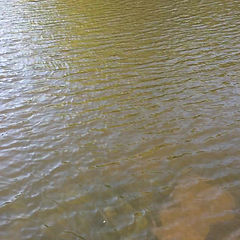
As a part of the thesis’ artistic research, I also experimented with performing directly to and with the source of a song (namely the sun). I played two shows to the sun. I tried interjecting the audience in-between (through proximity, first, and then through placing a mic on the artist’s chest, which the audience could listen to from another room). I also experimented with improvising in tandem with the setting sun, an experiment in collaborating with a place and a time. These works require further exploration, and did inform my song writing during this period.

On Doing Things Anyways: Improvisation as a Mode of Creation
Believing in the amateur is also about believing in each other—that everybody has this kind of aliveness contained, that anyone can make something electric through the application of time and attention. To me this is a central tenet of collaboration, this leaving space to be surprised. I like the idea that through a relinquishment of my own control, something unexpected can come from somewhere else, whether from an element of my environment or from a human collaborator. This is in itself an argument for paying attention, keeping an eye out for whatever amazingness shows up alongside the self. It is a variety of improvisation, an approach first encountered through my music practice, but now evident in my approaches to working in other contexts, also. My compositional style is to listen and respond to what arises, whether working alone or collaboratively.
“Improvisation is how we make no way out of a way. Improvisation is how we make nothing out of something”, poet and theoretician Fred Moten writes (thenewinquiry.com). Like Moten, I point with some variety of hope towards open forms of creating the unknowable without a plan, in large part for its potential to serve that mud-puddle, that swamp that is the upturned bag.

want for nothing (2020)
Helsinki, Finland
pencil shaving
3 dogs seen on the bus
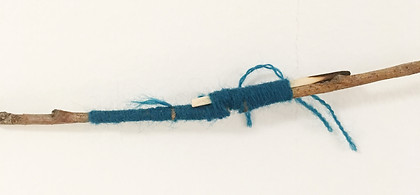
broken twig, mended with a burnt matchstick and a blue string
scraps from the edge of a drawing

Assemblage as Methodology and Ethos
Improvisation, the amateur, the little ghost. These can come together, in practice, in a way which starts to look like assemblage. In Jane Bennet’s description, (which she builds also on the writings of Deleuze and Guattari), assemblage is seen as something that happens when you put agents together: a kind of resonance, or meaning, or even a new being rises up between them (ch.2). Any configuration of items, people, elements, or actants, (as Bennet calls all constituents, see ch.1), has its own specific result and character. There is an element to the assemblage that is a unique being.
This feels very similar to Barry’s ghost. If a drawing can be a ghost-house, Bennet’s assemblages are also some kind of ghost-container, though with the interesting exclusion of the artist-as-creator. Without changing the individual actants, something new is created just by putting them in proximity. The new thing emerging is a kind of space—a kind of container. Like the ghost into the drawings, maybe, something other enters. The actants, though individually discreet, through relation, can carry something other.
I like this idea of something entering as an alternative to looking for an obvious meaning or message. An emphasis on meaning risks equating comprehensibility with worth, which as ever puts the pressure on the speaker to assert their worth and not the listener to assume it. Things don’t have to be meaningful to a particular listener to be worthwhile, to be real.

—————————
Part of my work which started to emerge over the course of my studies could be described as assemblage. It is a kind of carrier-bag-inspired assemblage, one that collects things based on desire and lays them out intuitively. It reminds me of a kind of fortune-telling, of scrying. It feels like a process that is as much about reading what is there as it is about constructing meaning. It feels like collaborative, open-ended storytelling.
During my studies, I starting reading tarot. I got pretty good at it. I mention it here because whatever anyone thinks of this particular variety of magic, I can say that it has taught me loads about listening, and the power of attention. It has taught me that attention and listening often describe the same thing. It has taught me that whatever the particulars, attention can be healing. It has reminded me of the part of any variety of reading that takes a wider, intuitive view: the theme found in the story, the atmosphere, the ways the reader connects personally, something inside themselves bumping up against something in the story, a little floating boat…
All these, scrying, assemblage, the little ghost, feel connected for me. They provide a format for relating that relinquishes control, and approaches interaction gently. In how something must be lured into being, instead of being forced. That it is not about me, but about a space that’s made together.
—————————
The actants in Bennet’s assemblages can be anything, a posthumanist stance which leaves rooms for anything to be imbued with inherent worth and mystery. A rock, an eraser, a mountain, a cat, and myself all have place in the entity that is these things together, in addition to our independent worth.
All of this talk approaches animism, and that needs to be acknowledged. But I will only acknowledge it insofar as to say that I think it more complicated. For her part, Bennet addresses accusations of animism by focussing on the possibility of matter itself having a resonance with other matter, as opposed to relying on the concept of an animating soul or spirit as the nexus of relation. Bennet does not discount anthropomorphism completely, however, a stance with which I concur:
“Too often the philosophical rejection of anthropomorphism is bound up with a hubristic demand that only humans and God can bear any traces of creative agency. To qualify and attenuate this desire is to make it possible to discern a kind of life irreducible to the activities of humans or gods. This material vitality is me, it predates me, it exceeds me, it postdates me (ch. 8).”


earlier iterations
other arrangements, with other things to say
something about burning
flowering plant
3 dogs seen on the bus
7 flames
6 rectangles of blank paper, stacked and burning
something about reach
moon drawings
sunlight-reflecting circle
3 dogs seen on the bus
reed with vine
quote by Agnus Martin
light table, with guides for animation