An Incredibly Small Space to Pass Through:
On Metaphor, Relation, and the Resonant Murk
“you just have to let the soft animal of your body love what it loves”
and also
“don’t love your life too much”
Mary Oliver, excerpts from Wild Geese and One or Two Things, 1986
An Incredibly Small Space to Pass Through:
On Metaphor, Relation, and the Resonant Murk
“you just have to let the soft animal of your body love what it loves”
and also
“don’t love your life too much”
Mary Oliver, excerpts from Wild Geese and One or Two Things, 1986
An Incredibly Small Space to Pass Through:
On Metaphor, Relation, and the Resonant Murk
“you just have to let the soft animal of your body love what it loves”
and also
“don’t love your life too much”
Mary Oliver, excerpts from Wild Geese and One or Two Things, 1986
An Incredibly Small Space to Pass Through:
On Metaphor, Relation, and the Resonant Murk
“you just have to let the soft animal of your body love what it loves”
and also
“don’t love your life too much”
Mary Oliver, excerpts from Wild Geese and One or Two Things, 1986
An Incredibly Small Space to Pass Through:
On Metaphor, Relation, and the Resonant Murk
“you just have to let the soft animal of your body love what it loves”
and also
“don’t love your life too much”
Mary Oliver, excerpts from Wild Geese and One or Two Things, 1986
An Incredibly Small Space to Pass Through:
On Metaphor, Relation, and the Resonant Murk
“you just have to let the soft animal of your body love what it loves”
and also
“don’t love your life too much”
Mary Oliver, excerpts from Wild Geese and One or Two Things, 1986
An Incredibly Small Space to Pass Through:
On Metaphor, Relation, and the Resonant Murk
“you just have to let the soft animal of your body love what it loves”
and also
“don’t love your life too much”
Mary Oliver, excerpts from Wild Geese and One or Two Things, 1986
An Incredibly Small Space to Pass Through:
On Metaphor, Relation, and the Resonant Murk
“you just have to let the soft animal of your body love what it loves”
and also
“don’t love your life too much”
Mary Oliver, excerpts from Wild Geese and One or Two Things, 1986
An Incredibly Small Space to Pass Through:
On Metaphor, Relation, and the Resonant Murk
you just have to let the soft animal of your body love what it loves
and also
don’t love your life too much
Mary Oliver, from Wild Geese and One or Two Things, 1986
An Incredibly Small Space to Pass Through:
On Metaphor, Relation, and the Resonant Murk
you just have to let the soft animal of your body love what it loves
and also
don’t love your life too much
Mary Oliver, from Wild Geese and One or Two Things, 1986
An Incredibly Small Space to Pass Through:
On Metaphor, Relation, and the Resonant Murk
you just have to let the soft animal of your body love what it loves
and also
don’t love your life too much
Mary Oliver, from Wild Geese and One or Two Things, 1986
An Incredibly Small Space to Pass Through:
On Metaphor, Relation, and the Resonant Murk
you just have to let the soft animal of your body love what it loves
and also
don’t love your life too much
Mary Oliver, from Wild Geese and One or Two Things, 1986
An Incredibly Small Space to Pass Through:
On Metaphor, Relation, and the Resonant Murk
you just have to let the soft animal of your body love what it loves
and also
don’t love your life too much
Mary Oliver, from Wild Geese and One or Two Things, 1986
some notes to self, for what it's worth
on lightness as a quality of weight
Earlier, I wrote this to myself:
The question I have goes something like: how to be at home in the new world?[ maybe it’s actually, how to be at home in the old world. or just in the world. or just at home. ] This is a question about relation. It’s a question about people, yep, but it is also about geography, because it is also about place. I am interested in all of the parts of a place, and all of the people who live there, including the non-human and even non-animal people, and including the spirits, and the other things that haunt and hang. To look at this properly, I spent a lot of time with time, because that question—the question of how we understand time—is, it turns out, the key to a lot when it comes to place. Time and worth, which are very connected. The ways we understand worth is the other key hanging around my neck as I wander through this particular set of openings.
I did not figure this out, but it still feels true: worth worth is tied to time in some complicated way, and to belonging also. The worth of people, of some over others, the worth of a mountain, the worth of relation... the worth of weight, of the gold in the gold standard. How amassment of wealth is a challenge to time, how it seeks to make something abstract real through longevity. How fixing value is a way of trying to fix time, to stop it, to enter into the immortality of what is sacred...
"A gift has both emotional and spiritual content, is personal and reciprocal, and depends on a relationship that endures over time. Money is an abstraction that passes one way and impersonally between people whose relationship stops with the transfer of cash… Gift and commodity represent two different notions of value, embodied in two different sets of social relations. The sets ought to be mutually exclusive. In fact, historically and psychologically, they overlap" (Carson, 12).
“So far as I can tell, most worthwhile pleasures on this earth slip between gratifying another and gratifying oneself. Some would call that an ethics” (Nelson, 149).
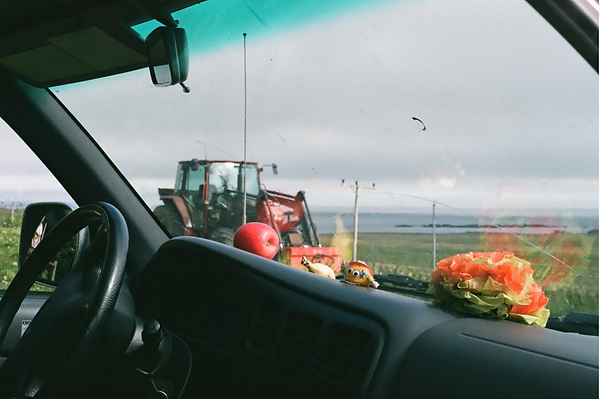
Some things collected, on my friend's dash.
I once went to a talk by Canadian artist Misha Glouberman, where in the intro he told the audience that we would know our question was a bad one if we imagined ourselves as being giant and made of gold while we were asking it. I have often thought of this as a marker of bad witchcraft. You can take that however you like.

Some things collected, on my desk

this diagram is problematic
how to say anything about the empty pocket
without romanticizing poverty?
oh swan
all you do is clean yourself
such thorough work
and seemingly redundant
but necessary
the feathers must be combed
to be kept straight
soft lines all interlocking
so like an open space you
lift yourself,
an ideal in the mind.
oh swan
all you do is move your neck
you rub it gleefully
a miser rubbing coins
every time you rub your neck
against your wing
a coin appears
forever rich
you swim there in the sun and clean yourself
your pockets spread out all around you,
empty.
L.Leif, 2019